Friday, March 31, 2006

Plagiarism and Malayalam Cinema

The other day I was watching Hitchcock's "Vertigo", and somewhere in the middle it started striking me that I have seen these scenes before. Where was it?. Towards the end it became very clear where it was, "Mannar Mathai Speaking"!!. Till now, I thought that Priyadarshan was the only director who maintains a very good collection of English movies. Now Sidiq-lal!. Copy "Vertigo" and call it "Mannar Mathai"!!... what a ripper.

The pioneer of this art has always been Priyadarshan. All the way, starting from Boeing Boeing(Boeing Boeing), Talavattom(One flew over the cuckoo's nest) to Nirnayam(The Fugitive), Kakkakuyil(loosely A Fish Called Wanda) and to his latest Malamaal Weekly. Over time, I believe he should get an honorary Oscar, for having watched and copied so many Hollywood movies. And others also chipped in... Ayushkalam(The Ghost), Life is beautiful(Dead poet's society), etc

I am not saying we should not copy good movies from elsewhere or get "inspired" by them. Infact, that is a good thing to do, bringing world cinema to Malayalam. But taking a psychological thriller like Vertigo and distorting it and making it a sub-plot of a comedy movie is simply un-acceptable. "Mannar Mathai" is a nothing movie, just a comedy flick, achieving nothing what Hitchcock wanted to convey and portray with the original. Maybe the producer was pushing Sidiq-lal too hard for a sequel to Ramji Rao, and they happened to rent the Vertigo CD, and got "inspired"!

Again Talavattam... scene by scene lift, but when it came to the scenes which mattered, the ripper destroyed it altogether. Where Jack Nicholson's character is put into a comma for standing up against the asylum authorities (for attacking the nurse who mentally demoralises and forces his friend to commit suicide), Mohanlal is put into a comma for having loved the doctor's daughter!!, how unimaginative... And "One flew..." ends with full of hope, "the Chief" who has been silent all this time, gets up, smothers Jack Nicholson (and does this with a smile in his face... yes a smile) shatters the hospital window and runs away to freedom, while Talavattam ends so hopelessly, we see Kartika becoming insane ...how dumb!. Still we remember Talavattam as one of the very good movies in malayalam. That's just the genius of a Lal and a Nedumudi. The silliness of the plot is very evident in the way Kyun KI bombed in the box_office last year.

So cutting short, moral of the story... Please do copy and get "inspired", if you can't be creative. But then please do it the Ram Gopal Varma way, acknowledge, copy to the full, and do not give us half baked "Indianised" versions.

Friday, March 24, 2006

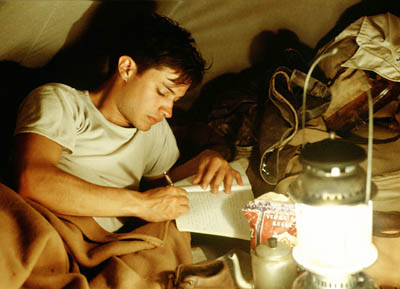
The Motorcycle Diaries

"The plan: to travel 8 thousand kms in 4 months. The method: improvisation. The goal: to explore a continent that we had only known in books. The equipment: La poderosa (the mighty one), an aged, leaky '39 Norton 500. The pilot: Alberto Granado, 29 years old and bio-chemist, self proclaimed "wandering scientist". The pilot's dream: to finish the trip on his 30th birthday. The co-pilot: Me, Ernesto de la serna el fuser, 23 years old"

Thus starts "The Motorcycle Diaries"... a story of 1950's , about a journey of two friends around South America. As the caption says "this is not the tale of heroic feats, It's about two lives running parallel for a while, with common aspirations and similar dreams."

I had heard about this movie long before. Finally, it took two DVD's (the first one got stuck in the middle, so I have to go and buy another one), two days, and two screenings (you have to watch it without the sub-titles again) to complete this. And it was worth all that. Granado's and Ernesto's travel is captured so brilliantly. One travels for his ideology, to explore the raw face of South America... and the other with a desire to f*** in every country, and if possible every town, in South America!!.

All through the movie, there is this Spanish guitar which continuously plays in the background and then ofcourse, there is the language, Spanish... the most romantic, or should I call it the most sensual, of all the languages in the world. I tried to learn Spanish online once, but the only thing that I could understand was that here(like in Hindi) each and every object is either a male or female. And the male ones will start with an El and the female ones with a La, so we have El Nino and La Nina and La Liga (the Spanish football league). And this El and La is what probably makes it the most sensual... the language of the nerudas and the marquezs.

And the movie progresses along what Ernesto sees around him, the natives, the disparities, the struggles... and the thoughts he has for them, which he writes in his letters to his mother during the journey. Like the one after he says goodbye to his girlfriend,

"On the boat I heard the moist slap of bare feet
and foresaw faces dark with hunger.
My heart was a pendulam
between her and the street.
I don't know what strength broke me
free from her eyes, loose from her arms.
She remained clouded by tears
her anguish hidden by the rain"

and when they cross to Chile at the tip of the continent, on a boat shrouded with mist,
"Dear mom what do we leave behind
when we cross a frontier?
Each moment seems split into two
Melancholy of what is left behind and
the excitement of entering a new land"

"The mighty one" finally breaks down in Chile. So they will have to cover all of Chile in a Truck, scale the Andes on foot and finally cross the Amazon on a raft. The film's final scenes are the most poetic and poignant. They finally reach the leper colony in the middle of Amazon, and Ernesto will swim one night across the river, to celebrate his birthday with the people, who are waiting for their death in the segregated island. Finally they reach Guajira in Venezuela, the northern tip of the continent. Granado will stay here and work as a bio-chemist and Ernesto will fly back to Buenos Aires to complete his degree in medicine, promising each other that they will meet soon.

"Motorcycle Diaries" ends with the following lines...
"It took eight years for ernesto and alberto to meet again. In 1960, Granado was invited to live and work in Cuba. The invitation came from his old friend Fuser, now "Commandante" Ernesto Che Guevera. One of the most prominent and inspiring leaders of the Cuban revolution. Che went onto fight for his ideals in the Congo and Bolivia, where he was captured and with the support of the CIA, murdered in October,1967. Forever faithful to his friend Fuser, Granado remained in Cuba, where he founded the school of medicine of Santiago. He lives in Havana, with his wife children and grand children"

Ever wondered how it is possible to feel nostalgic for a world one never knew... watch "Motorcycle diaries'

Tuesday, March 14, 2006

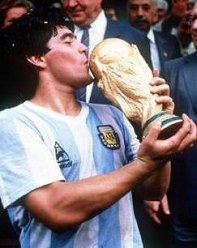
dIEGO

Was Diego my first idol?...nop. Like most people of my generation I had started loving Mohanlal from the time I understood movies. So then, when did I start loving Diego?. It must be during 1990, the ITALIA90, the World Cup. Back then, I was too young to stay awake all night and watch the game. But then I used to eagerly wait for the sports page in Mathrubhumi. And those days Mathrubhumi was a much better paper, and there was a lot of coverage for football too. The days when Kerala Police was winning all the cups in the town, the days of Sathyan, Vijayan, Papachan, Sharaf Ali, and Kurikesh Mathew.

I still remember seeing (or may be I saw it many years later) Maradona Magic overcoming Brazil and that sem-final with Italy which went to shoot-out. And then Argentina lost so controversially in the final. And nobody heard anything good about Maradona for a long time. Drugs,scandals,shooting journalists... that was all Maradona did for the next many years.

And then came USA94, my first complete world cup. And Argentina came to it as one of the favourites (like they have been doing for the last few world cups, only to crash-out early). And there was Maradona too, brought back from the wilderness, to re-create that magic. The first match against Greece will be remembered not for the powerful left foot volley that was Argentina's fifth goal, but the way he ran against a camera on the sideline and spit at it...Why did you have to do that Diego? Of all the people who were watching, there were thousand times more people who loved you than the ones who hated you.

And then there was that classic against Nigeria. I remember I had exams the next day, still I stayed awake all night to see Claudio Kaniggia curling one in from the touchline to seal an Argentine win. And the next day morning I went to school. Mavoor lies so close to Manjeri, Malappuram... Kerala's football heartland. And so there were so many die-hard fans around. I reached school, and we had this blackboard near the staircase where important notices were written. And the first thing I noticed was, somebody had written, "Maradona marunnadichu pidiyilayi"!.

That was the end of Diego Armando Maradona's international career. Never to don the colours of Argentina again, never to delight us with that amazing dribbling skills, never to promise so much and deliver so little... And then I forgot about him. Occasionally his picture used to come in the back page, that of an over-weight maradona, a divorced maradona, a hopitalized maradona... a going to die maradona.

And then, it was probably the "hand of god" that intervened again. Diego went to Cuba, came under intense treatment and dieting and slowly regained everything, most importantly his will-power. A knowledge that there is so much more he can do to the people who love him, for Argentina, for Latin America, for the world. Here he was, marching ten-thousand men along the streets of Buenos Aires, chanting slogans against Bush and imperialism,looking more trimmer than ever before.

Maradona now hosts an extremely popular talk-show, called "the night of the no:10" . Mainly dealing with his left leaning ideologies and anti-american/bush-ism. He has become so fit that many tip him to be Argentina's next coach!. In many ways, Maradona's life and Argentina's recent history are very much alike. A country trying hard to come out of a self inflicted economic disaster, would do well to have an icon like Maradona to rally its people around.

Dear Diego, I am happy to see you back. I love your ideologies and your politics. But for all the Bush battering and anti-imperialist resistance, we have Chavez (and he is doing a pretty good job in that). I want you to be back to where you belong, in the field, with the beautiful game. I want you to "play" again (as a coach ofcourse!). Dear Diego, I want you to stay alive...


(The inspiration for writing something for Maradona came, again thanks to Mathrubhumi, they had a sunday article (a few months before, which I saw only yesterday) on a group of people who set up a "Maradonian church", a religion to worship Maradona. According to the followers of the religion we are now in the year AD -47, "After Diego -47")

Saturday, March 11, 2006

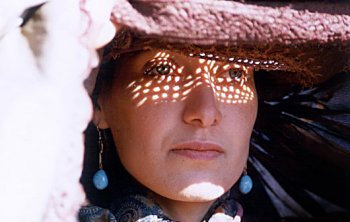
KANDAHAR

Kandahar is a movie about Afghanistan, the woman of Afghanistan, the veiled woman of Afghanistan. It is a film made by Mohsen Makhmalbaf, one of the best known film makers from the middle east. It was shot in 2000, when the Taliban were in power and were busy blasting off the Bamiyan Budhas. Before 9/11/2001, when Mr Bush probably wouldn't be able to locate Afghanistan in the map.

This is the adaptation of a real life story. Of two girls, Dyana and Nelofer, two close friends, one[Nelofer] who fled to Canada during the communist invasion and the other[Dyana] who stayed back. For nine years, Dyana and Nelofer kept in touch through letters. While Nelofer got a degree in English, Dyana trained as an economist and worked in a bank in Kabul, until she, along with all other Afghan woman, was forbidden to work when the Taliban came into power.

Some days later, Nelofer got a letter from Dyana saying that she[Nelofer] should live for both of them and that her own life in Afghanistan, under the Taliban rule, was no longer worth living. Worried that Dyana intended to kill herself, Nelofer traveled all the way from Canada to Afghan border, determined to stop Dyana. Nelofer made it all the way to Afghanistan border alone, but was unable to proceed as she was convinced by other refugees that the remainder of the journey was simply too dangerous. Forced to look for help elsewhere, she thought of Mohsen Makhmalbaf and hence this movie.

The movie is the self-narrated story of Nilofer's travel to Kandahar. On the way, we see Afghanistan as it was then and most probably a it is now. A place, if it was not for Bin-laden and Al-Qaida, wouldn't be of any interest to anybody, because, there are no consumers, no free markets and nothing to export except poppy. The movie has no other story, and only the following theme runs through...

About hope...HOPE
You know, a person needs a reason for living...
And in difficult circumstances, HOPE is that reason...
Ofcourse it is abstract,
but for the thirsty it is water,
for the hungry it is bread,
for the lonely it is love,
and... for women living under full cover,
hope is the day that she will be seeing!

The film has an awesome picturisation and a beautiful background score. The only flaw I could think was that it ends all too suddenly when you are yearning for a lot more.

There are two things which came to my mind after watching the movie, For one, Mohsen Makmalbaf is an Iranian, and like him there are a number of Iranian directors and actors who have been the favorites among film festivals all over the world. They make wonderful movies, bold movies, movies which will inspire people to voice for a change. Women in Iran are more educated , enjoy more liberties than in more economically forward Saudi or Kuwait. Iran also has one of the most powerful student's unions movements in the world. Compare this with the societies of Afghanistan, Pakistan, some parts of India... (I don't want to say some parts of Kerala, "Padam Onnu: Oru Vilapam" not withstanding).

Let us accept that Islam has a, u can say a west imposed, identity crisis. At a time, when we have to rally around societies like the Iranian one, to project them as models onto which the Afghanistans and the Pakistans should mature into, what are we doing!. We are actually cornering them, making the common man rally around the fundamentalists, and creating more fodder for Al-Qaida to grow, as if Iraq was not enough. There are surely more ways to solve a problem. Before the war everything was right in Iraq, except Saddam. And to correct one wrong all the rights were destroyed too.

And the second thing which came to my mind was, I remembered that the most beautiful eyes I ever saw was behind a burqa. It was in Hyderabad, somewhere near Hussainsagar lake. I can only wonder how much more beautiful this world will be without the veils.

Saturday, February 25, 2006

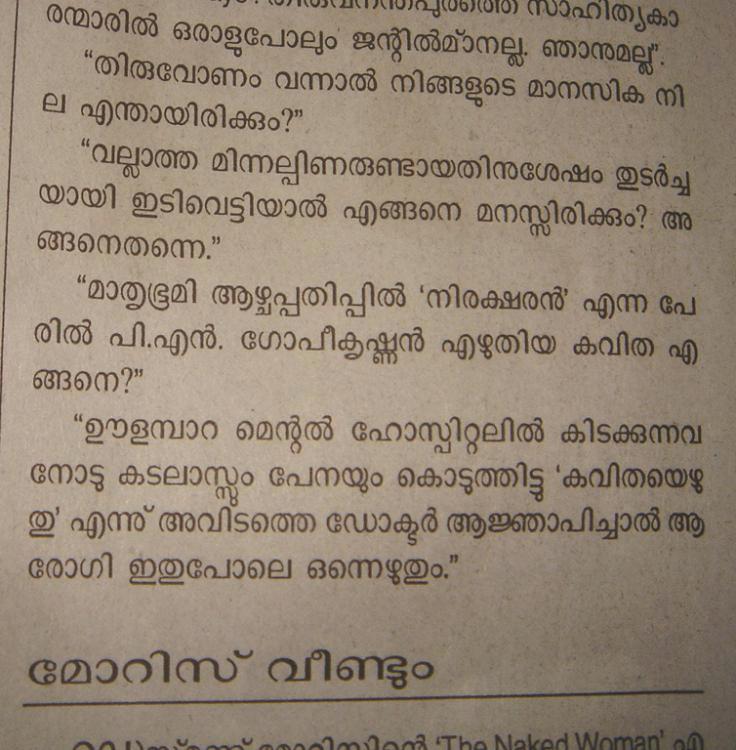
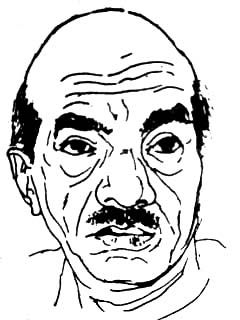
SAHITYAVARAPHALAKKARAN!!

For many years now I bought "Samakalika Malayalam Varikha" just to read one particular column. Those will be three (and sometimes four) innocuous looking pages somewhere in the middle, "Sahityavaraphalam" by M Krishnan Nair. And for last many months, since he was very unwell, most of the issues won't have the column. And the men who run the magazine very well know that there are a lot of people like me who are buying their weekly just for this particular piece. So after frantically searching through the entire length of the varikha and not finding the column, you return back to the first page, only to see in some corner, in the smallest fonts available, it will be mentioned as, "due to ill-health Krishnan Nair sir hasn't been able to write Sahityavaraphalam, we hope that our esteemed readers won't mind". And from now I can't even hope to see that, for the beloved Krishnan Nair Sir will never write the varaphalam again.

Column writers are very rare in Malayalam. I can't even think of anyone!. Other than the very popular political columns that EMS and Nayanar used to write in Deshabhimani, are there any?. Even in the Indian English Literary world, the only one that comes to my mind (and I follow eagerly), although it is more of current affairs, is the Sashi Taroor column in The Hindu. So under such a backdrop, how to describe 36 years of relentless, passionate "weekly literature forecasting"... amazing, unparalleled in world literature.

Since 1969, through many a weekly, Krishnan Nair englightened malayalis all over the world. Getting them closer to the master-pieces from all around, letting them know about the giants in world literature, whose names they would never have heard if not for Sahityavaraphalam. And at the same time, demolishing all the "budding-talents" and "big-wigs" of Malayalam literature back home.

Has Krishnan Nair ever said good words about malayali authors? Ofcourse!. Changampuzha was his favourite, along with P Kunhiraman Nair. While ONV and Vayalar were relegated to just "mattoli kavikal". Also he kept wondering from time to time, how Takazhi could get such "trash" like Chemmeen to be translated and read in countries where "Anna Karenina" was read :). This uncompromising approach (and language which sometimes bordered obscenity!! Just read Feb 1st week's "Malayalam" for a dose) won him more foes than friends.

But then we the readers were not complaining at all. It was amazing how well recieved this particular column was among all cross sections of people. All those people, many (including me) who never had (and never may) get the opportunity to read all those classics, got all they need from Sahityavaraphalam. It wasn't just literary criticism, it was urging people to read those books. Even the "chodyam-uttaram" part, so hilarious most of the times, and all his experiences with all the different people of Malayalam Literature and Politics (and he knew almost all of them), were all of the highest intellectual quality and showed the humungous amount of knowledge and experience that the person had.

Nobody expects that anything remotely similar will ever happen to Malayalam again. Last two years, we lost many of the truly real greats of Malayalam Literature, OV Vijayan, S Guptan Nair, Mundoor Krishnankutty.... but M Krishnan Nair's demise will be felt the most... Simply because there isn't any replacement available... Simply because there isn't anyone with such vast amounts of knowledge... Simply becuase there isn't anyone who can shred authors to pieces with a single sentence. We'll miss you sir!


(Current Books has published an assortment of "Sahityavaraphalam's". Currently they are showing it as out of stock. Also "Malayalam varikha" is available online.

I should have written "Sahityavarabhalam" rather than "Sahityavaraphalam". One thing Krishnan Nair would never compromise was incorrect grammar and pronunciation )

Friday, February 10, 2006

Hey, go take a walk!

(a beautiful article written by our "Diversity Director". Reproduced here without his permission by a fellow "walker"...)

"He who sits still in a house all the time may be the greatest vagrant of all; but the saunterer, in the good sense, is no more vagrant than the meandering river, which is all the while sedulously seeking the shortest course to the sea. For every walk is a crusade!" - Henry David Thoreau

I'm a walker. I do between 20 and 30 miles a week now. Walking is therapeutic, plus there's ample enough evidence of its cardiovascular benefits. It's also a great time for vigorous mental "workouts," soul-searching and nature (and people) watching. When you're out there alone you belong exclusively to yourself, hemmed in by your memories, your imagination, the sounds of the wind, birds chirping and an occasional yapping dog.
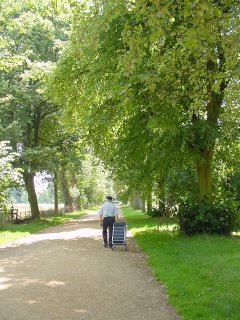
The very act of walking is steeped in historical tradition. For centuries people walked, many for social justice. In her book, Alter Your Life, Kathleen Hall devotes an entire chapter to a few historical anecdotes of great people walking. "Buddha spent his life walking from village to village," Hall writes. "And Susan B. Anthony spent her entire life walking so that women could participate in the democratic process through voting." Dr. Martin Luther King, Jr. was renowned for the marches he led. And pilgrimages are part of many spiritual traditions, Hall points out.

More contemporarily, many people walk as a sign of unity, or to make political or social statements. I recall with lots of pride participating in a "walk against hate" with members of the local Muslim community months after Sept. 11. Many walk to raise funds for Juvenile Diabetes and other worthy causes. In short, walking serves many purposes.

In many ways, walking provides a perfect opportunity to observe "diversity in motion," to peer into the inner sanctums of how people experience and behave in the world we live in. Plus, walking sometimes presents unexpected opportunities to do a bit of good for others.

For example, on last Thanksgiving Day I had an incredible experience while out walking; one that I would have missed had I remained ensconced in my favorite living room chair. You see, I happened across a lost wallet that morning, one stuffed with credit cards, cash and — more important to the owner, I suspect — some irreplaceable family photos.

Later, at the neighborhood Starbucks, I had the exhilarating pleasure of calling the wallet's owner to tell him the good news. He was elated. For me that experience was sweeter than the strawberry cheesecake I had later that day. Thus, walking sometimes offers up unexpected opportunities to do good deeds.

Notice life's contrasts
Walking can bring us face to face with types of social contrasts which may cause us to bump up against our comfort zones. Recently, for example, I observed an immaculate golf course on one side of the road and, on the other, an unkempt pasture, littered with weeks-old newspapers and other trash. A construction crew had just begun work on the latter side. The "temporarily tanned" inhabitants on the golf course swung golf clubs, while the "permanently tanned" ones across the street swung picks and shovels. I was fascinated by how they seemed to render the other invisible by avoiding, unconsciously perhaps, direct eye contact with "those people" across the street. When you walk you notice the little things, the subtleties, the contrasts.

Farther down the road, more litter. Candy and cigarette wrappers and lots of empty beer bottles. Against better judgment, I picked up one of those beer bottles. I couldn't help but form a mental image of the person in whose body the contents of that bottle ended up, and how carelessly they tossed it out the window. My thoughts then shifted to the image and the lives of those who must pick up all that trash, by avocation or for reasons of sheer inconvenience.

How interesting it would be, I thought, for the trash "tossers" and trash "retrievers" to meet face to face over a cup of coffee — not beer — for a rational discussion of their bipolar roles in "litter management." When you walk, you imagine all kinds of possibilities.

With dusk quickly settling in around me, I decided to shortcut it across the nearby Target store parking lot to save a little time. But it didn't take long for me to notice the many empty shopping carts strewn across the lot, not a single one that far from nearby return stations.

I stopped, stared and touched one particular cart while asking myself what manner of man, or woman, would deny that cart its rightful place next to its brethren in the return station less than 20 yards away? And who is this person who cheated himself out of a small opportunity for exercise? When you walk you can't help but question human motives.

Heavy traffic on diversity highway
With a mile to go I came upon an intersection and a buildup of traffic where many different makes and sizes of vehicles converged. I got to thinking about how the diversity "highway" has gotten pretty cluttered as well these days, with the incredible blend of cultures, generations, religions, languages and ethnicities; a sometimes combustible mix leading to a diversity "fender bender" or bout of "road rage" every now and then.

The closer I got to the intersection, my imagination put me in the front seat next to the nameless occupants in those cars, trucks, SUVs and motorcycles. Who are they and what's on their experience "odometers," I wondered. What's locked away in their trunk that's valuable, untapped and underutilized? When you walk, your imagination takes you all over the place.

So the next time someone tells you to "go take a hike," hey, take them up on it. There are no traffic jams. Elevators, escalators and stairwells are nonexistent. A bottle of water will suffice for gasoline at 2 bucks a gallon. You'll think about and notice things you've never thought about or noticed before. Your diversity IQ will expand. And you just may stumble across an opportunity to do something extra special for someone during one of those treks.

And in the end, your family physician, along with those in your organization charged with monitoring benefit costs, will be elated with the new and healthier you. Oops, there it is in preceding line ... the most compelling reason yet supporting the business case for taking a stroll!

Now, go take a hike!

Saturday, February 04, 2006

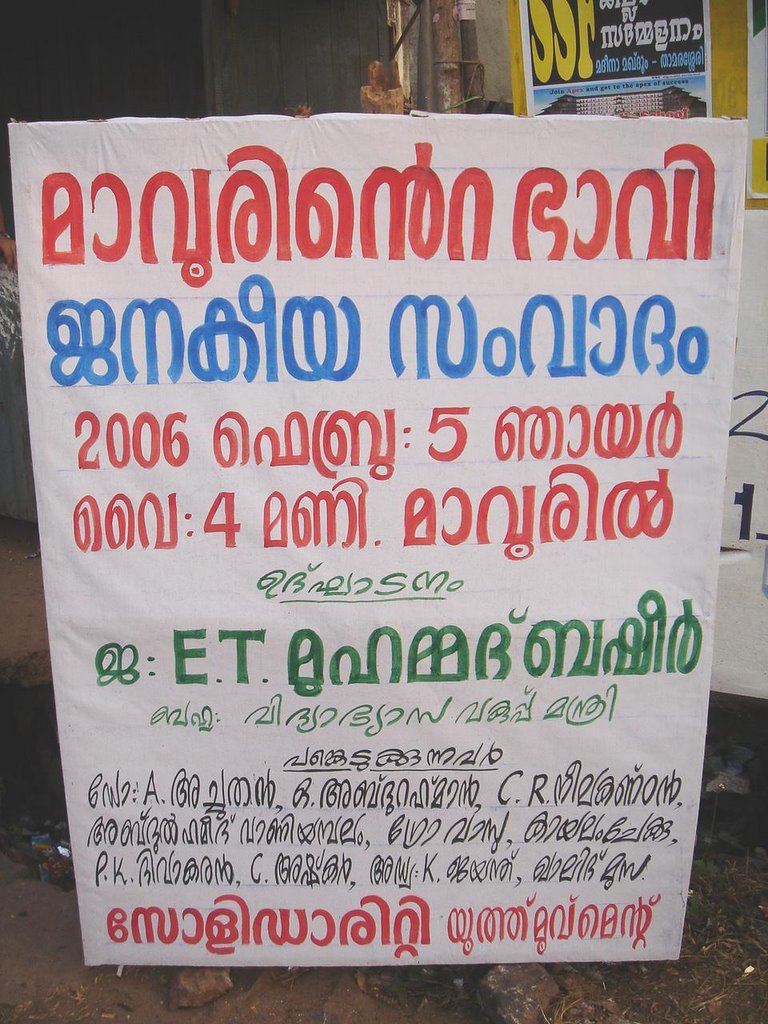
MAVOOR: Oru Deshathinte Kadha - Vol. III

Mavoorinte Bhaavi?:

So the giant chimneys no longer spit toxic gases, the sirens will no longer be heard thrice a day and Mavoor will never see those long serpentine queues of bamboo laden trucks. Maybe we all managed to prevent a disaster from happening, another tragedy in the lines of Union Carbide and Bhopal. And for now the waters of Chaliyar won't be black...

But may be we should spare a thought for the more than 3000 people who lost their jobs, and for their families too. Many who spent their entire lives in Mavoor, and many who didn't have a skill set to fetch them jobs outside of Grasim. All those families who had no places to go when they were evicted from their quarters. All those shops and merchandise which mushroomed and survived along with Grasim. Well, many survived ,many didn't. The situation of some people are grim, especially those who were attached to the school, those who were conveniently forgotten by the unions during the compensation talks. But people will find a way to survive. After all these years, when I went back to Mavoor, I was quite surprised to see that most of the shops were still open and functioning as were most of the buses. As Ian Malcom famously says in "Jurassic Park" , "life finds a way (to survive)".

Discussions are going around on what will be Mavoor's future. What to do with those vast swathes of industrial wasteland. Unfortunately, I don't see anything happening in near future. Mavoor can only be useful for those heavily polluting , water guzzling behemoths. And given the experience of Grasim, people will not prefer them anymore. And to expect that IT/ITES concerns can be accommodated here is nothing short of day-dreaming, Mavoor (and for that matter Calicut) is no Kochi!. Let me hope that I'll be proved wrong, and something good will indeed come to Mavoor soon. But all those newcomers will now have to start it all over again, for some of the old inhabitants of Mavoor have slowly but surely made their way back ... SNAKES!


(the end...) PART I, PART II, Recent Photos


Anubandam: Thanks for all the comments. It is a great feeling to know that so many people still remember and love Mavoor.